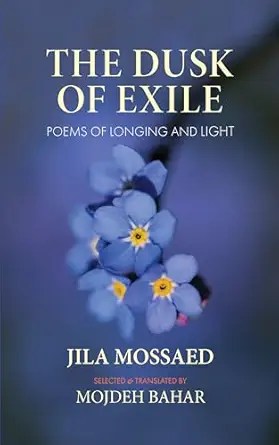
Coming March 3, 2026: The Dusk of Exile: Poems of Longing and Light
Born in Tehran and now a member of the Swedish Academy, Jila Mossaed is one of the most distinctive poetic voices of exile and belonging. Having written in both Persian and Swedish, she brings to her Persian poetry a rare perspective on language and loss—illuminating the fragile threshold between silence and speech, home and displacement, memory and renewal.
In these radiant translations, drawn from Mossaed’s eleven Persian collections, we enter a world where exile becomes a form of vision. The natural world—wind, sea, stone, and flame—mirrors the inner life of the poet, revealing how loss can sharpen perception and how solitude can become a dwelling place. Mossaed’s poetry moves through tenderness and clarity, sorrow and radiance, until longing itself becomes a kind of home.
Mojdeh Bahar’s faithful and lyrical translations bring this extraordinary body of work into English for the first time, allowing readers to encounter a voice that bridges cultures, histories, and languages.
The Dusk of Exile is a book about the endurance of the human spirit—an intimate and timeless testament to how poetry can transform displacement into light.
Praise for The Dusk of Exile: Poems of Longing and Light
In these taut and tantalizing texts, Swedish-Iranian poet Jila Mossaed struggles with finding herself, both literally and figuratively, as she wanders this world. She exhorts us to “open the suitcases/ so the suns we folded away/ between pillows burn once more.” Her one constant is poetry, Mossaed’s “heart’s mute confidant.” Indeed, she entrusts with us her final instructions: “After my death/ scatter the dust
of my bones/ for the birds to eat/ so that poetry will drip/ from their beaks.” Sensitively translated by Mojdeh Bahar, references to Persian mythology, poets, and poetic forms are seamlessly woven into these lines. —Nancy Naomi Carlson Winner, Oxford-Weidenfeld Translation Prize
“These poems are intensely personal, and the individual authenticity of their cry cannot be doubted, but in a time of so many diasporas, exiles, displaced persons, refugees, they convey the often unspoken experience of millions of our contemporaries. Mojdeh Bahar’s translations are beautifully and meticulously transparent to their Persian originals.” —Dick Davis, poet and translator of Shahnameh
“These searing, lacerating poems by Jilla Mossaed have been made into a powerful English by their brilliant translator Mojdeh Bahar . The poems move through loss, memory and the search for roots, where home turns from a territory to a tension between remembrance and survival. The poet questions God and challenges the reader to go through the skin to the beating heart of the poet’s suffering. Ultimately the poems are a fierce attempt to remember in the eternal struggle of memory against forgetting. In Stranger she writes “Forget/where I was born/ I, too, have forgotten.” Indran Amirthanayagam, author of Seer
“The Dusk of Exile is a wonderful read. Jila Mossaed’s poetry is deeply universal; inspiring us humans to reflect on our own transient and precarious sense of belonging.” —Fathali M. Moghaddam, Professor of Psychology, Georgetown University
Available for preorder on Amazon!
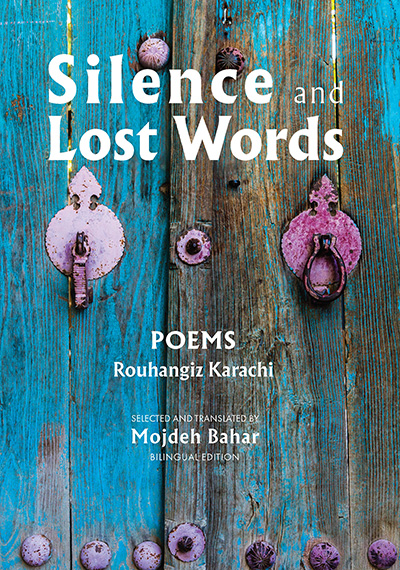
Silence and Lost Words
Rouhangiz Karachi was born in Firuzabad, an ancient Iranian city located between Shiraz and the Persian Gulf. Poetry has always played an important role in her life; she was allowed to enter primary school at age six because she could recite poetry.
Her four poetry collections in Persian depict women’s social struggles and internal tensions. For over forty years, Karachi’s scholarly work has also focused on Iranian women, poets and protagonists alike. With the insightful perspective of a poet, and the skill of a scholar, Karachi’s “woman” appears universal. Very few of her poems have a uniquely regional or ethnic color, allowing all readers to identify with, and be deeply affected by them. Her poems give a strong sense of introspection, keeping an unkind world at bay-a magnificent, exquisitely disciplined literary gift has been brought to bear upon the unbearable.
Silence and Lost Words: Poems is a selection from Karachi’s acclaimed collections, but also includes eleven of her unpublished poems in English and Persian. Mojdeh Bahar’s marvelous translations make this collection as accessible to a casual fan of poetry as to a comparative literature scholar.
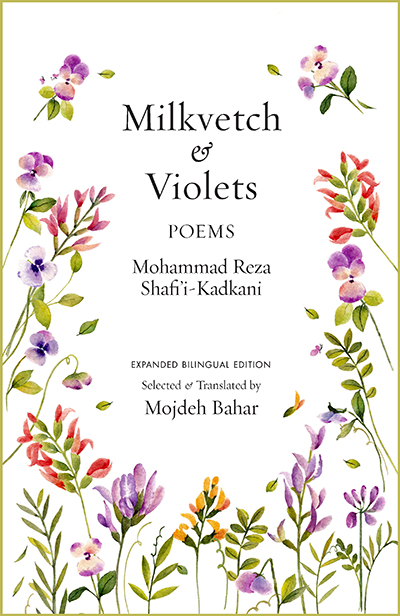
Milkvetch & Violets: Expanded Bilingual Editition
Mohammad Reza Shafi’i-Kadkani is a contemporary Iranian poet, literary critic, editor, author, and translator born in 1939. His nature poetry, which comprise most of the poems in this book, are harbingers of hope. His wildflowers and birds anticipate the arrival of spring. His milkvetch contemplates its predicament but finds a way to convey its message through the breeze. His wintersweet outsmarts the drought; his mountain osier, pine and petunia are the songs of life; his rain cleanses the earth and purifies the words; his poppy is reckless, his sea fearless; his jasmines and sweetbriars are miraculous. Kadkani is at once a modern poet and a classical one, well versed in both traditions. His themes, language, and style are unique, fusing the old with the new, the classic with the modern. Mojdeh Bahar was born in 1973 in Iran to a family of poets and writers. Her parents emigrated to the U.S. when she was 14. Although she is a patent lawyer by profession, she continues her deep interest in Persian poetry. This is her first book of translations from one of her favorite contemporary Persian poets.
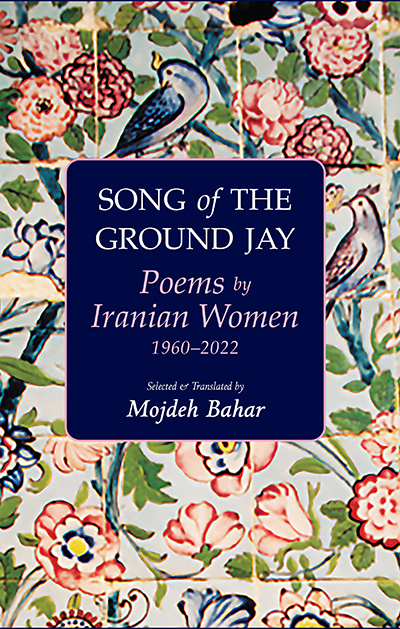
Song of the Ground Jay: Poems by Iranian Women, 1960–2022
Iranian women have been writing Persian poetry for over a thousand years, and in the tumult of our contemporary moment, poetry has emerged once again as an outlet with a unique power to move and connect us, to inspire fury, tears, joy, laughter, and surprise.
In this bilingual anthology, encompassing both the most progressive and the most regressive eras for women in Iran, Mojdeh Bahar introduces readers to the poems of Iranian women during the past sixty years. Focusing mainly on poets writing today, Song of the Ground Jay engages with a diverse array of Iranian women’s voices that includes the full spectrum of aesthetic sensibilities—with varying styles, tones, and themes, painting a dynamic and cohesive portrait of modern Persian poetry by women.
For anyone who has wanted to try their hand at a conversation with contemporary Persian poetry by Iranian women but doesn’t know where to start, Song of the Ground Jay opens a door and invites you to walk in.
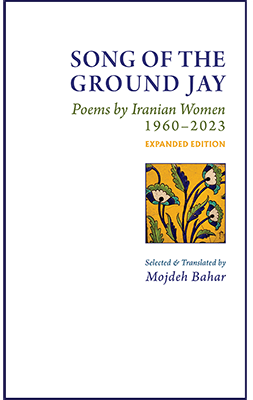
Song of the Ground Jay: Poems by Iranian Women 1960–2023, Expanded Bilingual Edition
Iranian women have been writing Persian poetry for over a thousand years, and in the tumult of our contemporary moment, poetry has emerged once again as an outlet with a unique power to move and connect us, to inspire fury, tears, joy, laughter, and surprise.
In this expanded bilingual anthology encompassing both the most progressive and the most regressive eras for women in Iran, Mojdeh Bahar introduces readers to the poems of 104 Iranian women during the past sixty years. Focusing mainly on poets writing today, this expanded edition of Song of the Ground Jay engages with a very diverse array of Iranian women’s voices that includes the full spectrum of aesthetic sensibilities—with varying styles, tones, and themes, painting a dynamic and cohesive portrait of modern Persian poetry by women.
For anyone who has wanted to try their hand at a conversation with contemporary Persian poetry by Iranian women but doesn’t know where to start, Song of the Ground Jay opens a door and invites you to walk in.
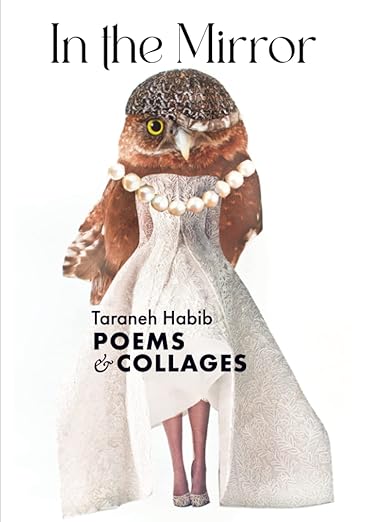
In the Mirror: Poems & Collages
Abstract, surreal, and dreamy, In the Mirror: Poetry and Collages moves back and forth across the porous border between language and image, and captures the fleeting moments of modern life: longing, grief, freedom, liberation, and much more. Within these pages, the author addresses the relations between modern poetry, collage, and the nonconceptual life of the intellect.
An Iranian woman who emigrated to the U.S. with her husband and young children in the 1980s, Taraneh Habib is a poet, artist, and scholar of Islamic gnosis: knowledge, awareness, and wisdom. Her previous work, all written in Persian and published in Iran, include a collection of surreal short stories entitled Tanasokh (Reincarnation), followed by Negah Mikonam va Nemibinam (I Look and I Don’t See), a novella Tabagheh-ye Sevvom (Third Floor) a novel, Aparteman-e Shishe’i (The Glass Apartment), and a poetry and collage collection Si-o Se Morgh (33 birds).
In the Mirror: Poetry and Collages is an empowering collection that takes the reader on a journey of love, healing, exile, self-discovery, and personal transformation. Taraneh Habib lives and works in Washington, DC., and this is the first collection of her work translated into English.
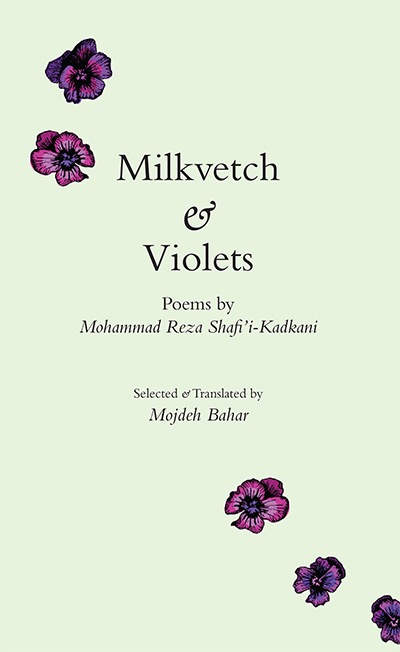
Milkvetch & Violets
Mohammad Reza Shafi’i-Kadkani is a contemporary Iranian poet, literary critic, editor, author, and translator born in 1939. His nature poetry, which comprise most of the poems in this book, are harbingers of hope. His wildflowers and birds anticipate the arrival of spring. His milkvetch contemplates its predicament but finds a way to convey its message through the breeze. His wintersweet outsmarts the drought; his mountain osier, pine and petunia are the songs of life; his rain cleanses the earth and purifies the words; his poppy is reckless, his sea fearless; his jasmines and sweetbriars are miraculous. Kadkani is at once a modern poet and a classical one, well versed in both traditions. His themes, language, and style are unique, fusing the old with the new, the classic with the modern.
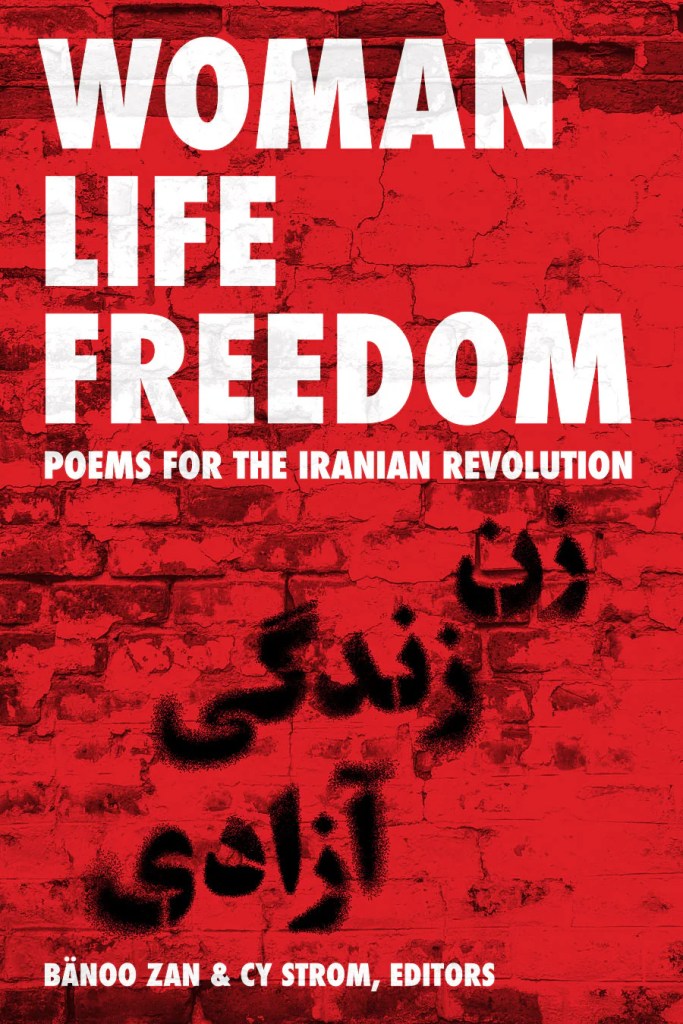
Woman, Life, Freedom: Poems for The Iranian Revolution
This international anthology marks a world-historical moment: the first ever feminist revolution. The slogan chanted by the demonstrators in Iran is Woman, Life, Freedom, and it encompasses hopes and ideals for all people everywhere. This anthology echoes that cry. The poems here might be reflections on the present moment, denunciations of injustice, examinations of the poet’s own conscience, laments for the fallen, bitter curses, prayers, celebrations of life, and visions of a better future. Bänoo and Cy aim to raise awareness of the women’s revolution in Iran and show the world that this cause is alive and will not be put down.
 Mojdeh Bahar